
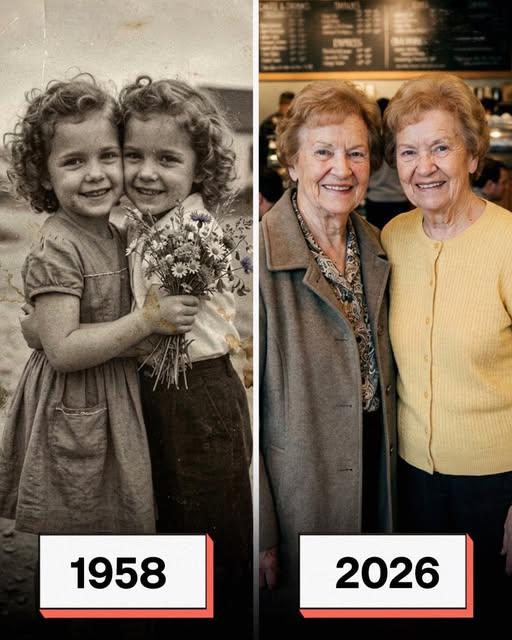
When I was five years old, my twin sister walked into the woods behind our house… and never came back.
At least, that’s what I was told.
The police said they found her. My parents said she was gone. But there was no funeral I can remember, no grave I was ever shown—no real explanation. Just silence that stretched across decades… and a quiet feeling that something about it never quite added up.
My name is Dorothy. I’m 73 now. And my entire life has been shaped by the absence of someone who should have been there beside me.
Her name was Ella.
We weren’t just twins—we were inseparable. We shared everything: our bed, our thoughts, even our emotions. If one of us cried, the other felt it. If one laughed, the other followed.
She was the fearless one.
I was the one who stayed close behind.
The day she disappeared, we were staying with our grandmother while our parents were at work.
I remember being sick—feverish and weak—lying in bed while Grandma sat beside me, pressing a cool cloth to my forehead.
“Rest,” she whispered. “Ella will play quietly.”
Ella was across the room, bouncing her red ball against the wall, humming to herself. I can still hear that soft rhythm… and the rain beginning to fall outside.
At some point, I drifted off.
When I woke up, something felt wrong.
The house was too quiet.
The ball was gone. The humming had stopped.
“Grandma?” I called.
No answer.
Moments later, she rushed in, her face tight with worry.
“Where’s Ella?” I asked.
“She’s probably outside,” she said—but her voice wasn’t steady. “You stay here.”
I heard the back door open.
Then I heard her call Ella’s name.
At first, it sounded normal.
Then louder.
Then urgent.
After that, everything blurred.
Neighbors came. Police arrived. Questions filled the air—questions I was too young to understand.
“What was she wearing?”
“Did she talk to strangers?”
“Where did she like to go?”
That night, searchlights cut through the rain and darkness in the woods behind our house. Voices echoed, calling her name again and again.
They found her red ball.
That’s the only thing anyone ever clearly told me.
The search continued, but answers never reached me.
I remember my grandmother crying softly in the kitchen, repeating, “I’m so sorry,” like it was something she couldn’t undo.
When I asked my parents when Ella was coming home, everything changed.
“She’s not,” my mother said.
“Why?” I asked.
“That’s enough,” my father snapped.
Later, they told me she had been found.
“In the woods,” my mother said quietly.
“She died,” my father added. “That’s all you need to know.”
But it wasn’t enough.
I never saw a body.
I don’t remember a funeral.
One day, I had a twin.
The next… I didn’t.
Her things disappeared. Her name stopped being spoken. It was like she had been erased.
At first, I kept asking questions.
“Where did they find her?”
“What happened?”
“Did it hurt?”
Each time, my mother would shut down.
“Stop asking,” she’d say. “You’re hurting me.”
I wanted to tell her I was hurting too.
But instead, I learned to stay quiet.
I grew up carrying that silence.
From the outside, my life looked normal. I did well in school, made friends, built a family.
But inside, something was always missing.
A space shaped like my sister.
At sixteen, I went to the police station alone.
“I want to see the file,” I told them.
They refused.
“Some things are better left alone,” the officer said gently.
I walked out feeling more alone than ever.
Years later, I tried one last time with my mother.
“I need to know what happened,” I told her.
She froze.
“What good would that do?” she whispered. “You have your life. Don’t reopen that pain.”
“But I’m still living in it,” I said.
She never answered.
So I stopped asking.
Life moved forward, as it always does.
I got married. Had children. Became a grandmother.
From the outside, my life was full.
But in quiet moments, the absence returned.
Sometimes I’d set the table and instinctively think of two places.
Sometimes I’d wake up convinced I heard a child calling my name.
Sometimes I’d look in the mirror and wonder if the face staring back was what Ella might have looked like.
My parents died without ever telling me the truth.
I thought that was the end of it.
It wasn’t.
Years later, I traveled to visit my granddaughter at college.
One morning, while she was in class, I went to a small café nearby.
It was warm, crowded, full of chatter.
I stood in line, barely paying attention—until I heard a voice.
Something about it made me stop.
The tone. The rhythm.
It felt… familiar.
I looked up.
And there she was.
A woman at the counter—about my age. Same height. Same posture.
Then she turned.
And it was like looking into a mirror.
I walked toward her, my heart pounding.
She stared at me, just as stunned.
“Oh my God,” she whispered.
“Ella?” I said, before I could stop myself.
She shook her head slowly.
“My name is Margaret.”
I apologized, embarrassed—but she stopped me.
“No,” she said softly. “Because I was just thinking the same thing.”
We sat down together.
Up close, the resemblance was undeniable.
Same eyes. Same features. Even our expressions matched.
Then she said something that changed everything.
“I was adopted.”
My heart dropped.
She told me she had always felt like something was missing—like part of her story had been hidden from her.
I told her about Ella.
About the woods.
About the silence.
Then, at the same moment, we asked:
“What year were you born?”
When we compared dates, the truth began to take shape.
We weren’t twins.
But we were something else.
Connected.
When I got home, I searched through the documents my parents had left behind.
At the bottom of a box, I found it.
An adoption record.
A baby girl.
Born years before me.
Same mother.
There was also a note—written in my mother’s hand.
She had been young. Unmarried. Forced to give the baby away. Not even allowed to hold her.
But she never forgot.
I sent everything to Margaret.
We took a DNA test.
The results confirmed it.
We were sisters.
People expect a story like this to end with a perfect reunion.
It doesn’t.
You can’t replace decades overnight.
But we talk.
We share pieces of our lives.
We learn each other—slowly, carefully.
And we face the truth together.
My mother had three daughters.
One she was forced to give away.
One she lost.
And one she raised in silence.
It doesn’t make everything right.
But it helps me understand.
Because pain doesn’t excuse silence—
but sometimes, it explains it.
And after a lifetime of not knowing…
understanding is something I never thought I’d have.
Leave a Reply