
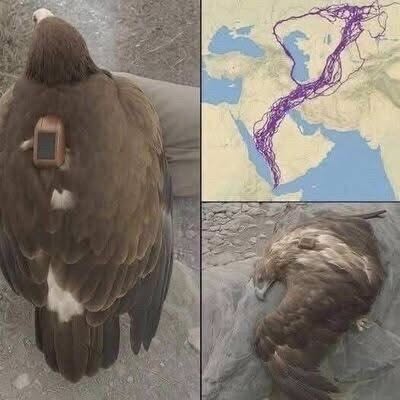
The eagle’s migration revealed a pattern of remarkable precision and adaptability, as it traveled consistently between northern Russia and the warmer regions of the Arabian Peninsula. Rather than choosing the shortest path, it followed coastlines, mountain ranges, and natural land corridors—routes that offered safer passage, reliable rest stops, and better access to food while conserving energy.
Researchers observed that the bird depended heavily on thermals—rising columns of warm air that allow large birds to glide with minimal effort. By avoiding vast stretches of open water, where these air currents are weaker, the eagle demonstrated a highly refined survival strategy shaped by instinct, experience, and an acute awareness of its environment.
Beyond the scientific insight, the journey carries a broader message. It suggests that the most effective path is not always the quickest, but the one guided by patience, awareness, and the ability to adapt. At the same time, it underscores the importance of wildlife research and conservation, reminding us how vital it is to protect the ecosystems that support such extraordinary migrations.
Leave a Reply