
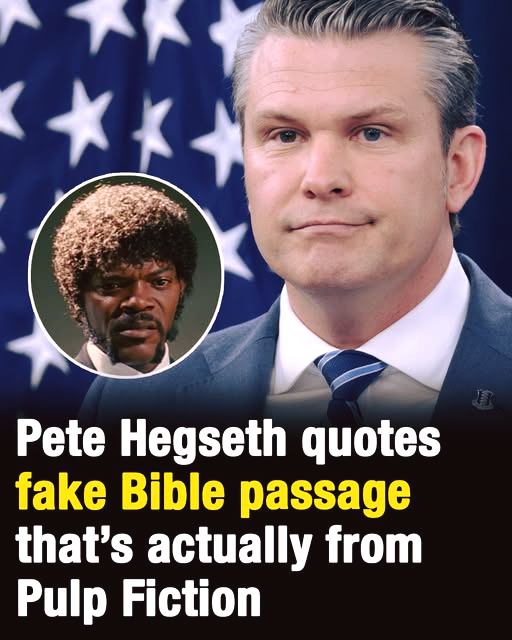
The situation involving Pete Hegseth quickly gained traction across political media and social platforms, drawing widespread attention from commentators, journalists, and everyday users online.
What began as remarks delivered during a Pentagon prayer gathering soon evolved into a broader public conversation about accuracy, context, and the use of religious language in official government settings.
Much of the reaction centered on a passage Hegseth recited, which many noted closely resembled a famous monologue from Pulp Fiction rather than a direct quotation from scripture.
The confusion stemmed in part from the film itself, which drew inspiration from Bible—specifically the verse Ezekiel 25:17—creating an overlap in language that was recognizable to audiences familiar with both sources.
As clips of the speech spread online, social media activity surged, with users expressing a mix of surprise, criticism, and humor over the apparent mix-up during an official event. Some questioned how such wording could appear in a formal setting, while others debated whether it was intentional or mistakenly attributed.
The moment quickly grew beyond a simple quoting issue, becoming part of a wider discussion about political messaging, religious references, and communication standards in government institutions.
Media commentators emphasized the importance of precision when citing religious texts, especially in ceremonial or official contexts. The situation also renewed attention on the longstanding role of faith-based language in American political discourse.
In this case, however, the blending of cinematic dialogue and biblical phring created a level of confusion that fueled widespread interpretation and debate.
As the story gained momentum, the Pentagon issued a response to clarify the context of the remarks. Sean Parnell, serving as a senior public affairs official, addressed the situation in a public statement shared on social media.
He explained that the wording referenced by Hegseth was tied to a tradition used by certain military personnel, particularly within search and rescue contexts. According to the statement, the phrasing had been influenced by Pulp Fiction, which itself drew loosely from biblical language.
Parnell further stated that this layered origin—religious text, cinematic adaptation, and modern usage—was acknowledged during the remarks, pushing back against claims that the reference had been mistakenly presented as direct scripture.
Despite that clarification, reactions remained divided. Some accepted the explanation, viewing the reference as contextual and culturally informed. Others argued that blending fictional dialogue with religious text in an official setting created unnecessary ambiguity and raised concerns about clarity.
The episode ultimately became part of a larger pattern in modern political discourse, where symbolic language and cultural references are often closely scrutinized.
Over time, the initial surge of online reaction began to fade, though the story continued to circulate in commentary and analysis. Observers noted how quickly a single line from a speech can spread, be reinterpreted, and turn into a national talking point within hours.
In the broader picture, the incident highlighted how religion, pop culture, and political communication can intersect in unexpected ways—and how easily that intersection can spark debate in a fast-moving media environment.
As attention gradually shifted elsewhere, the Pentagon maintained its position that the reference had been properly contextualized. Still, public interpretation remained varied, reflecting the complexity of how language is understood in modern political settings.
In the end, what started as a brief moment in a speech became a widely discussed example of how quickly words can travel—and how differently they can be interpreted once they do.
Leave a Reply