
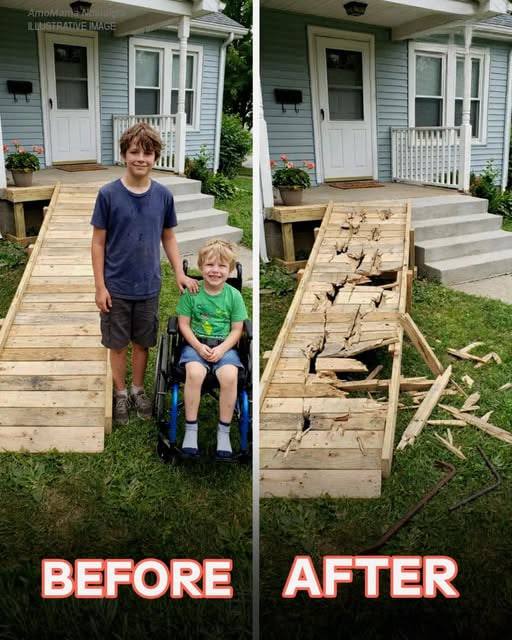
I thought it would be just another quiet afternoon—until my son noticed something the rest of us had somehow learned to ignore. By the next day, the whole street felt different.
My son Ethan is twelve. He’s the kind of kid who doesn’t walk past a problem just because it isn’t his.
Across the street lives Caleb, a nine-year-old boy who spends most of his time in a wheelchair on his front porch. Quiet. Observant. Watching the neighborhood like it’s a life happening just out of reach.
At first, I didn’t question it. People adjust. Kids adapt.
But Ethan didn’t see it that way.
“He’s always just watching,” he said one afternoon while we were bringing in groceries.
Caleb sat there again, hands resting on his wheels, eyes following a group of kids racing down the sidewalk.
Ethan frowned. “Mom… why doesn’t he ever come down?”
I looked over, really looked this time, and saw what he meant.
“I don’t know,” I said. “But we can go ask.”
That was enough for him.
That evening, we walked over. And the moment we saw the front of the house, everything clicked.
Four steep steps.
No railing.
No ramp.
No way down without help.
We knocked, and Caleb’s mom, Renee, answered. She looked tired—but warm.
When I explained why we came, she gave a small, worn smile.
“He wants to go out more than anything,” she said. “But without a ramp, someone has to carry him every time.”
Ethan didn’t say anything. But I could see the shift in his face.
“We’ve been saving,” she added. “But it’s slow. Insurance won’t cover it.”
We thanked her and headed home.
Ethan was quiet the whole way back.
That night, instead of reaching for his phone, he sat at the kitchen table with a pencil and paper.
“What are you working on?” I asked.
“I think I can build something,” he said, still sketching.
His dad had taught him how to work with his hands. Ever since we lost him three months ago, Ethan hadn’t touched his tools much.
Until now.
The next afternoon, he emptied his savings onto the table.
Coins. Bills. Everything.
“That was for your bike,” I reminded him.
“I know.”
“You’re sure?”
He met my eyes. “He can’t even leave his porch.”
That was the end of the conversation.
At the hardware store, he was focused—asking questions, checking measurements, thinking it through like it mattered. Because to him, it did.
For three days, he worked every afternoon until the light faded.
Cutting. Measuring. Adjusting. Starting over when something didn’t feel right.
I helped where I could—but this was his project.
On the third evening, he stepped back, wiped his hands, and said, “It’s not perfect… but it’ll work.”
We carried it across the street together.
Renee came outside, confused at first—then stunned.
“You made this?” she asked.
Ethan nodded.
We set it in place, secured it, and stepped back.
Renee looked at Caleb. “Want to try?”
He hesitated for a moment… then rolled forward.
Slowly, carefully—he made his way down.
The second his wheels touched the sidewalk, his face lit up.
Within minutes, kids gathered around him. Someone asked if he wanted to race.
And just like that, he wasn’t watching anymore.
He was part of it.
For one evening, everything felt exactly the way it should be.
Until the next morning.
I woke to shouting and ran outside.
Mrs. Harlow, a neighbor from down the street, stood in front of the ramp, visibly furious.
“This looks awful!” she snapped.
Before anyone could react, she grabbed a metal bar and swung it.
The first hit cracked the wood.
Caleb cried out.
Ethan froze.
She didn’t stop. Strike after strike until the structure gave way and collapsed.
Then she dropped the bar like it meant nothing.
“Get rid of it,” she said, and walked off.
The silence that followed felt heavier than the noise.
Caleb was back at the top of the steps.
Watching.
Again.
Inside, Ethan sat on his bed, staring at his hands.
“I should’ve made it stronger,” he said quietly.
“No,” I told him. “You did something good.”
“But it didn’t last.”
I didn’t have an answer for that.
Not then.
The next morning, three black SUVs pulled onto our street.
They parked in front of Mrs. Harlow’s house.
Men in suits stepped out—calm, composed, purposeful.
They went straight to her door.
At first, she looked confident when she answered. Almost pleased.
But that changed quickly.
Her smile faded.
Her posture stiffened.
Her hands started to shake.
“We need to discuss your application,” one of them said.
They introduced themselves as representatives from a private foundation—one that had been considering her for a major leadership role.
Part of their process, they explained, involved observing how candidates behaved when they thought no one important was watching.
Then they showed her a video.
The sound of wood breaking.
Caleb’s voice.
Her own words.
Her face lost all color.
“You destroyed access for a child,” one of them said evenly.
“We look for people who build things up—not tear them down,” another added.
Just like that, the opportunity she’d been waiting for was gone.
But they weren’t finished.
“What happened here also showed us something else,” one of them said.
He gestured toward the empty lot behind her house.
They planned to turn it into a fully accessible community space—ramps, smooth paths, adaptive equipment. A place where no child would be left on the sidelines.
Something permanent.
Something no one could tear down.
Renee stepped forward.
Mrs. Harlow looked at her. “You sent that video.”
Renee didn’t deny it.
“You took something from my son,” she said calmly. “I made sure someone saw.”
Then one of the men turned toward us.
“Is Ethan here?”
Ethan stepped forward slowly.
“There will be a new ramp,” the man said. “Built properly, installed permanently.”
He paused.
“And we’d like to dedicate it in honor of your father.”
I felt my throat tighten.
Ethan reached for my hand.
Later, Renee told me she used to work with the foundation. When she saw what happened, she knew exactly who needed to see it.
That afternoon, Caleb was still on the porch.
But this time, he wasn’t just watching.
He was smiling.
And for the first time since everything happened—
it felt like something better was already on its way.
Leave a Reply