
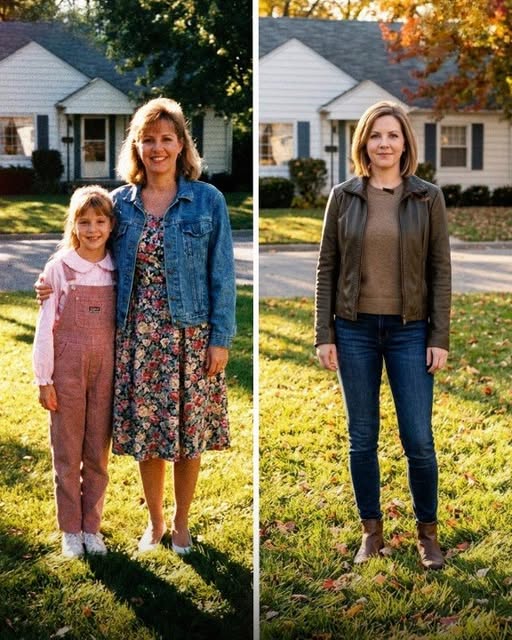
I had always thought it was just the two of us.
My mother, Margaret… and me.
Growing up without a father made our world feel smaller than everyone else’s. On Father’s Day, while other kids shared stories about their dads, I stayed quiet. My mother always gave the same gentle answer whenever I asked.
“It’s always been you and me, Claire,” she’d say. “And that’s enough.”
For a long time, I wanted to believe her. And for a while, I did.
But even as a child, something about our relationship felt distant—like a thin wall between us I could see but never reach.
She provided everything I needed in a practical sense—food on the table, clean clothes, a stable home, opportunities for education. Our life was structured, predictable, and safe.
Emotionally, it was different.
She wasn’t cruel—just reserved, careful, controlled.
No hugs when I cried. No late-night talks about my dreams or fears. No warmth that I saw in other mother-child relationships.
As a child, I would sometimes stand at her bedroom door at night, hoping—just once—she might soften.
“Mom?” I’d whisper.
“Yes, Claire?”
“Can I sleep in your bed tonight?”
There would always be a pause, then the same calm answer:
“You’re a big girl. You’ll be fine.”
I nodded and walked back to my room, pretending the ache didn’t hurt as much as it did.
Eventually, I stopped asking.
She rarely came to my school events. When she missed them, it was always migraines or work. Over time, I stopped expecting her to show up. Less disappointment, fewer questions.
So I learned to rely on myself.
I built my own life, piece by piece.
After college, I moved to another city, started a career, surrounded myself with friends who gave the warmth I had quietly craved. From the outside, everything looked complete.
But deep down, one question never went away:
Where did I truly stand with her?
When my mother passed away, I thought the question would finally be answered. Instead… it only grew more confusing.
The will was read in a quiet office. Tense and hopeful, I waited.
Then came the shock.
I wasn’t mentioned.
Not in the way I expected.
No inheritance. No savings, no property, no keepsake.
Everything, including the house I had grown up in, went to the housekeeper—a woman who had been with us for years.
I froze. It didn’t feel like grief. It felt like rejection. Deep, familiar rejection.
Days later, unable to let it go, I returned to the house. Something inside me insisted there had to be more—something I hadn’t yet seen.
I searched. Slowly. Methodically. Room by room. Drawer by drawer.
Until her bedroom.
Beneath the mattress, hidden inside a sealed envelope, I found it.
A letter.
My hands trembled as I opened it, fear and hope twisting together in my chest.
And as I read, everything began to shift.
The letter wasn’t cold. It wasn’t distant. It was honest.
For the first time, she spoke about things she had never shared with me while alive. Choices, struggles, fears I hadn’t imagined.
She explained the housekeeper wasn’t just an employee. She had been there during moments I never witnessed—times when my mother was overwhelmed, when she needed help but didn’t know how to ask.
She admitted something that cut deeper than any inheritance ever could:
She knew she had failed me emotionally.
Not because she didn’t love me… but because she didn’t know how to show it.
She grew up in a home where affection was absent, where emotions were hidden, where love was never spoken. That was all she had ever known.
With me, she was afraid.
Afraid of doing it wrong. Afraid of not being enough. Afraid that trying might make things worse.
So she did what felt safe. She provided. She protected. She controlled what she could. And in doing so… she kept her distance.
Then came the part about the house.
Leaving it to the housekeeper wasn’t about replacing me. It wasn’t about loving someone else more. It was about gratitude. About making sure someone who had supported her in ways I never saw would be secure.
For me… she believed she was leaving something different. Not money. Not property.
Strength. Independence. The ability to live and build on my own terms.
At the end, her words slowed, as if writing them had been a struggle:
“Claire, I may not have shown you love the way you needed it. But I never stopped loving you. Everything I did… was my imperfect way of trying.”
I sat there long after I finished reading. Not crying. Not angry. Just still.
For the first time, I understood her—not as the distant mother I had known, but as a flawed person who had loved me in the only way she knew.
It didn’t erase the hurt. It didn’t replace the moments I never had.
But it gave those empty spaces meaning.
For years, I believed distance meant indifference.
Now I see it can mean fear. Or limitation. Or a kind of love that never learned to speak.
I will always wish things had been different.
But I no longer question whether I mattered to her.
Her final words gave me what I had spent my life searching for: certainty.
Sometimes, what we inherit isn’t money or property… but the truth left behind when someone can no longer speak it aloud.
Leave a Reply