
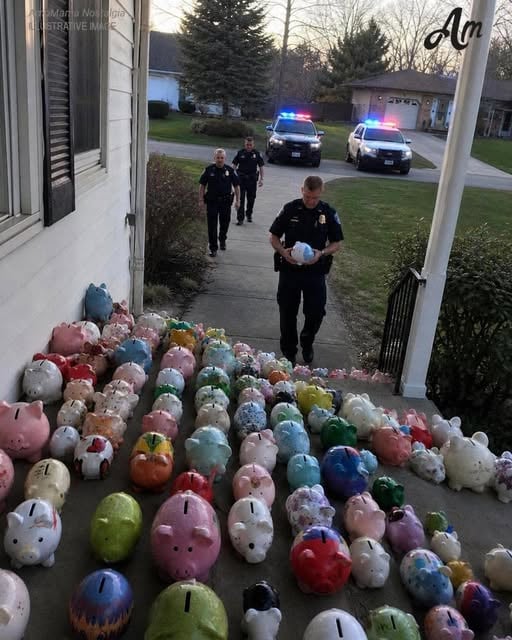
By the time the last piggy bank was opened, the story had changed shape entirely.
It wasn’t about missing savings anymore.
It wasn’t even about a mysterious overnight return.
It was about a woman—Adele—who had spent years quietly holding up people who never realized they were being held.
Electric bills she paid without telling anyone. Grocery bags left on porches. Pharmacy runs she framed as “extra errands.” Small, invisible acts that never made it into anyone’s version of her life.
Every piggy bank we opened added another piece to that hidden history. A note tucked inside a toy jar. A gift card taped under a lid. A scrap of paper with a single sentence:
You saw me when no one else did.
The officers stopped taking notes after a while.
So did I.
Even the yard—still full of open containers and scattered markers—felt less like a crime scene and more like something we weren’t supposed to be witnessing all at once.
At one point, my son knelt beside her porch step and pressed his small hand into hers.
“I didn’t know you did all that,” he said simply.
Adele smiled, tired but steady.
“That’s the point, sweetheart,” she replied. “People shouldn’t have to know in order to be helped.”
Later, when the last box was sealed and the last officer left, the neighborhood didn’t feel the same.
Not louder.
Not happier.
Just… more aware.
I stood in our yard long after everything quieted, looking at the empty spaces where the piggy banks had been.
What unsettled me wasn’t what we had uncovered.
It was how long it had gone unnoticed.
My son tugged my sleeve again.
“Mom,” he asked, “did I do something big?”
I looked down at him.
Yes, I thought.
But what I said was simpler.
“You started something that was already trying to happen.”
And somewhere down the street, a porch light flicked on that hadn’t worked in months.
Leave a Reply