
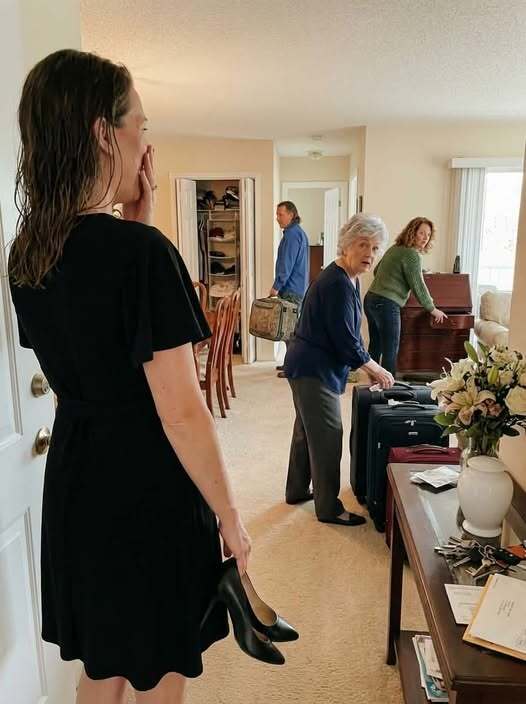
As I slid the key into the lock, the weight of my black dress clung to me like grief that hadn’t yet learned how to leave. I expected silence—thick, respectful, the kind that follows a funeral when a home finally acknowledges what it has lost.
Instead, I heard movement. Too much of it.
The moment the door opened, I stepped into chaos.
The living room—once filled with quiet mornings, shared coffee, and Bradley’s soft laughter—had been turned into a staging ground. Suitcases were lined up along the walls. Closet doors hung open like wounds. His family moved through the space with unsettling purpose, as if they were not intruders, but executors of something already decided.
At the center stood Marjorie Hale.
She didn’t look at me like a grieving mother. She looked at me like an inconvenience that had overstayed its welcome.
“This house is now family property,” she said flatly. “Everything Bradley owned belongs to us. You need to leave.”
No hesitation. No compassion. Just certainty.
Declan was already sealing a suitcase. Fiona was rifling through drawers like she was inventorying a storage unit instead of dismantling a life. They avoided my eyes completely—like acknowledging me would make this theft harder to justify.
On the dining table sat a handwritten list in Marjorie’s sharp, decisive script. Categorized. Divided. Claimed.
And beside it, untouched, was Bradley’s urn.
Small. Quiet. Ignored.
As if even his death had been reduced to something inconvenient in their way.
I asked, barely above a whisper, “Who let you in here?”
Marjorie lifted a brass key without hesitation. “Bradley did. Years ago. This is still a family home.”
Fiona scoffed as she pulled open another drawer. “You’re just a widow now. Don’t complicate things.”
That word should have broken me.
Instead, something inside me shifted into stillness.
Because six days earlier, in a hospital room that smelled of antiseptic and rain-soaked regret, Bradley had held my hand tighter than he had ever held anything in his life.
And he had told me: When they come, don’t argue first. Just call Elena.
So I did something they didn’t expect.
I laughed.
Not softly. Not politely. But in a way that cut through the room like glass.
The room went still.
Marjorie frowned. “Have you lost your mind?”
I wiped my face slowly. “No. I just realized something. You all never actually knew him.”
Declan scoffed. “We knew Bradley.”
“No,” I said quietly. “You knew what you could take from him.”
The silence that followed wasn’t peace. It was uncertainty.
Because none of them had ever understood the life Bradley built away from them.
The patience. The discipline. The systems.
The protection.
My phone buzzed once in my hand.
Elena: We’re downstairs.
I exhaled once, steady and controlled.
“You really should have read what he signed,” I said.
Marjorie’s expression tightened. “There is no will.”
“That’s what you think,” I replied.
A knock echoed through the apartment.
Not soft. Not accidental. Official.
When I opened the door, everything changed.
Elena Cruz stood there, composed and unshaken, a deputy beside her and a sealed black folder under her arm.
Behind them, the building manager waited silently.
The atmosphere in the room shifted immediately—like the air itself had been corrected.
Elena didn’t raise her voice. She didn’t need to.
“The property is held in a private trust,” she said calmly. “Occupancy has been revoked. You are here unlawfully.”
Marjorie tried to speak over her, insisting on ownership, on family rights, on claims that sounded louder than they were real.
Elena simply opened the folder.
Documents. Transfers. Revocations. Signatures.
Finality, written in ink.
Then she placed a second set of evidence on the table.
Security footage.
Marjorie at the door. Declan moving through locked drawers. Every unauthorized entry captured, timestamped, undeniable.
The room didn’t erupt.
It collapsed into silence.
Not the kind that comes from grief.
The kind that comes from being caught.
One by one, the suitcases were ordered closed. The belongings returned. The illusion of entitlement dismantled piece by piece.
When they were finally escorted out, Marjorie paused at the door, her voice lower now.
“You think this protects you?”
I looked at her, calm in a way I hadn’t been before.
“No,” I said. “He did.”
And for the first time, she had no answer.
Later, when the apartment was finally still again, Elena handed me a single flash drive.
“Bradley wanted you to see this last,” she said.
I sat at the dining table—the same place they had tried to erase him from—and pressed play.
Bradley appeared on screen.
Tired. Frail. But steady.
“If you’re watching this,” he said softly, “then they didn’t respect the boundaries I tried to set in life. So I’ve set them in law instead.”
He paused, almost smiling.
“And I made sure they would never win by misunderstanding me again.”
When the video ended, the apartment felt different.
Not empty.
Protected.
Outside, the city moved on as if nothing had changed.
But inside that home, for the first time since the funeral, nothing was being taken anymore.
Leave a Reply