
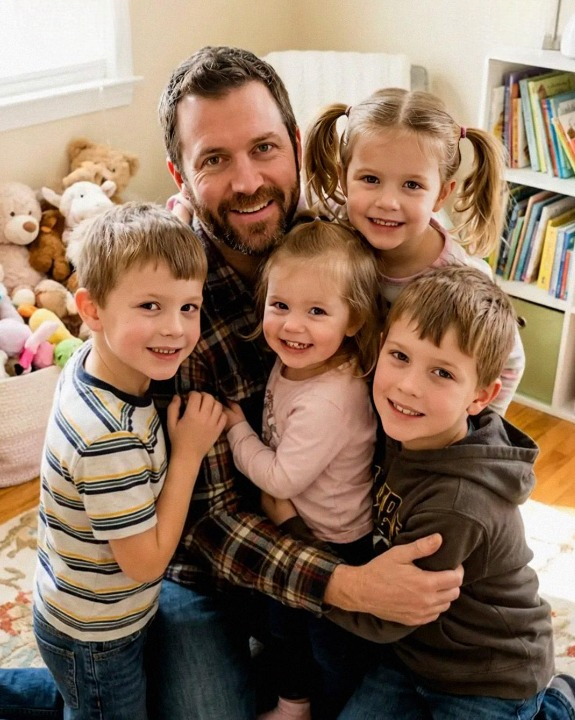
Two years after losing my wife and six-year-old son in a car accident, I was barely holding my life together. Then one night, a post about four siblings on the verge of being separated changed everything.
My name is Michael Ross. I’m 40.
Two years ago, my life ended in a hospital hallway.
A doctor looked at me and said, “I’m so sorry.”
That was all it took.
My wife, Lauren, and our son, Caleb, had been hit by a drunk driver.
“They didn’t suffer,” he added—like that was supposed to make it easier.
It didn’t.
After the funeral, the house felt wrong.
Lauren’s mug was still by the coffee maker.
Caleb’s sneakers sat by the door.
His drawings were still taped to the fridge.
Everything was exactly the same—except they were gone.
I stopped sleeping in the bedroom. I couldn’t.
I crashed on the couch with the TV on, just to avoid the silence.
I went to work. Came home. Ate whatever was easiest.
People told me I was strong.
I wasn’t.
I was just still breathing.
About a year later, I was sitting on that same couch at two in the morning, scrolling through Facebook.
Mindless posts. Vacation pictures. Arguments I didn’t care about.
Then something stopped me.
“Four siblings need a home.”
It was a post from a child welfare page.
There was a photo—four kids sitting close together on a bench, almost pressed into one another.
The caption explained everything: their parents had died, no relatives could take all four, and if no one stepped forward soon, they’d be separated into different homes.
That one line stayed with me:
“They will likely be separated.”
I stared at the picture.
The oldest boy had his arm protectively around one of the others. The youngest clutched a stuffed animal like it was the only thing holding her together.
They didn’t look hopeful.
They looked like they were bracing for something worse.
I checked the comments.
“Heartbreaking.”
“Praying for them.”
“Shared.”
But no one said, “I’ll take them.”
I put my phone down.
Then picked it back up.
I knew what it felt like to walk out of a hospital alone, with everything gone.
And now those kids—after losing their parents—were about to lose each other too.
I didn’t sleep much that night.
By morning, I had already made up my mind.
I called the number in the post.
“Child Services, this is Karen,” a woman answered.
“My name is Michael Ross,” I said. “I saw the post about the four siblings… do they still need a home?”
“Yes,” she replied. “They do.”
“Can I come in and talk?”
We set a time for that afternoon.
On the drive over, I kept telling myself I was just gathering information.
I wasn’t.
Karen laid a file on the table.
“They’re good kids,” she said. “They’ve just been through a lot.”
She went through their names: Owen, nine. Tessa, seven. Cole, five. Ruby, three.
“Their parents died in a car accident,” she explained. “No extended family can take all four.”
“So what happens if no one does?” I asked.
She hesitated. “They’ll be placed separately. It’s what the system allows.”
I stared at the file.
“Is that what you want?”
“No,” she said quietly. “But it’s often the only option.”
I didn’t think any longer.
“I’ll take all four.”
She blinked. “All four?”
“Yes. If the only reason they’re being separated is that no one will take them together… then I will.”
She studied me for a long moment. “Why?”
“Because they’ve already lost enough.”
The process took months—background checks, interviews, evaluations.
One therapist asked me bluntly, “How are you handling your grief?”
“Not well,” I admitted. “But I’m still here.”
The first time I met them, all four were sitting on a couch, pressed together like they were one unit.
“Are you the one taking us?” the oldest asked.
“If you want me to be,” I said.
“Will you take all of us?” Tessa asked, eyes sharp.
“All of you,” I said. “I’m not here for just one.”
“What if you change your mind?”
“I won’t,” I told her. “You’ve had enough people do that already.”
That seemed to land.
The youngest peeked at me and asked, “Do you have snacks?”
I smiled. “Always.”
The day they moved in, my house stopped feeling empty.
Shoes by the door. Backpacks on the floor. Noise—so much noise.
It wasn’t easy.
Ruby cried at night.
Cole tested every boundary.
Tessa watched everything, waiting for things to fall apart.
Owen tried to take care of everyone—and wore himself out doing it.
Once, Cole yelled, “You’re not my real dad!”
“I know,” I said calmly. “But that rule still stands.”
Little by little, things shifted.
Ruby started falling asleep during movies on my chest.
Cole drew pictures of us holding hands.
Tessa handed me forms to sign—using my last name.
And one night, Owen paused at my door and said, “Goodnight… Dad.”
I answered like it was the most normal thing in the world.
But inside, it meant everything.
A year later, life wasn’t perfect—but it was real. Busy. Loud. Full.
Then one morning, someone knocked on the door.
A woman in a dark suit stood there, holding a briefcase.
“Are you Michael Ross? The adoptive father of the four siblings?”
“Yes,” I said. “Is something wrong?”
“They’re fine,” she assured me. “My name is Susan. I was the attorney for their biological parents.”
That got my attention.
We sat at the kitchen table as she opened her folder.
“Before their deaths, their parents prepared a will,” she explained. “They created a trust for the children.”
“A trust?” I repeated.
“A modest one,” she said. “A small house and some savings. It all belongs to the children. You’ve been named guardian and trustee.”
I exhaled slowly. “Okay… that’s good.”
She nodded.
“But there’s something else.”
I felt my chest tighten.
She turned the page.
“Their parents were very clear about one thing,” she said. “If anything ever happened to them… they did not want their children separated. Under any circumstances.”
I sat there, stunned.
“They wrote that?” I asked.
“Yes.”
I swallowed hard.
While the system had been preparing to divide them… their parents had already fought to keep them together.
Without knowing any of that—
I had done exactly what they wanted.
“Where’s the house?” I asked.
She gave me the address.
That weekend, I took the kids.
We pulled up to a small house with a tree in the yard.
The car went quiet.
“I know this place,” Tessa whispered.
“This was our house,” Owen said softly.
I looked at them.
“You remember it?” I asked.
And in that moment, everything came full circle—
They hadn’t just found a home with me.
Somehow…
they had found their way back to a part of the one they lost.
Leave a Reply