
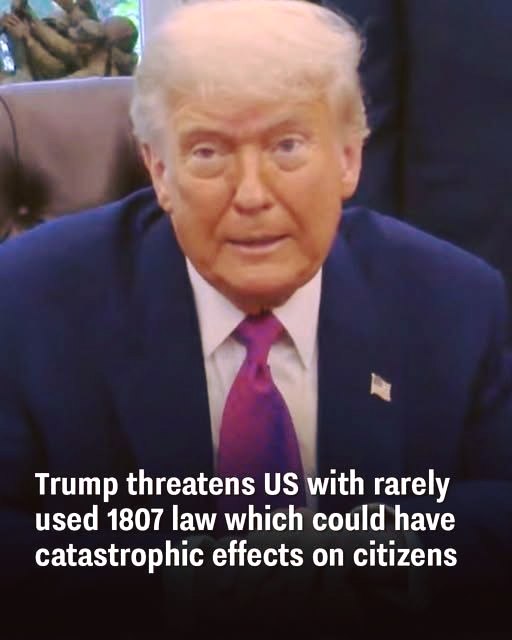
In recent weeks, public debate in the United States has intensified over the role of federal military forces in domestic environments, raising renewed questions about constitutional limits and democratic oversight.
Reports and commentary have drawn attention to the presence of military personnel in certain urban areas, prompting broader discussion about the boundaries between civilian governance and federal authority. What might once have seemed like a distant legal issue is now being examined in real time, as observers consider how these powers could be applied.
At the center of this debate is the legal framework governing military involvement within U.S. borders—particularly long-standing statutes designed to prevent direct military enforcement in civilian life.
One of the most frequently cited is the Posse Comitatus Act, which generally restricts the use of federal armed forces in domestic policing. For generations, it has served as a key safeguard of civil-military separation, reinforcing the principle that everyday law enforcement should remain under civilian control.
However, exceptions exist. Chief among them is the Insurrection Act of 1807, which grants the president authority to deploy military forces within the country under specific conditions, such as civil unrest or obstruction of federal law. Though rarely invoked, it provides significant executive discretion—something that continues to spark debate among legal scholars and policymakers.
Supporters of broader executive authority argue that such powers are essential during extraordinary circumstances, particularly when local institutions are overwhelmed. From their perspective, the ability to respond quickly at the federal level can be crucial to restoring order and protecting public safety.
Critics, however, caution that expanding military involvement in civilian spaces risks eroding democratic norms and weakening local governance. They argue that introducing military forces into domestic situations blurs the line between policing and warfare, potentially affecting civil liberties and public trust.
Another concern centers on the fundamental differences in training and mission. Military forces are structured for defense and combat operations, while civilian law enforcement emphasizes de-escalation, accountability, and community engagement. Whether those differences can be effectively reconciled in high-pressure domestic scenarios remains an open and deeply contested question.
As the conversation continues, the issue is not just about legal authority—but about how a democracy defines the balance between security and civil control in moments of uncertainty.
Leave a Reply