
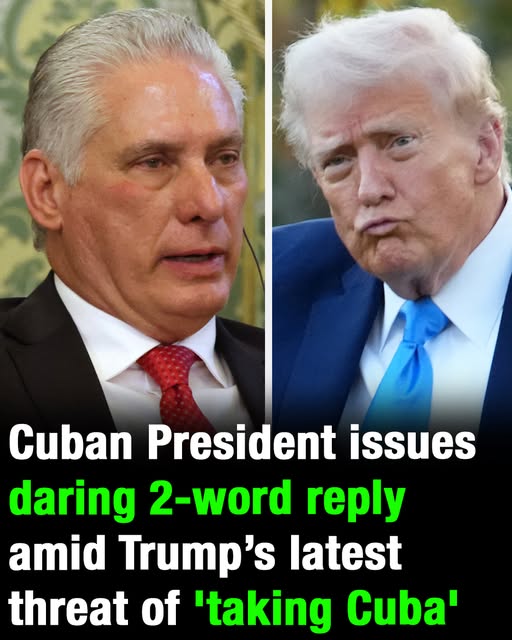
The latest exchange between Donald Trump and Miguel Díaz-Canel highlights rising tensions between the United States and Cuba—tensions that have been building for months under economic pressure, political rhetoric, and growing instability in the region.
Since returning to office, Trump has taken an increasingly aggressive stance on foreign policy, particularly in Latin America. His administration has tightened sanctions and enforced an energy blockade that has contributed to Cuba’s worsening economic crisis, including widespread blackouts and fuel shortages.
At the same time, Trump has made a series of controversial remarks suggesting that the U.S. could take action against Cuba. In previous statements, he described the island as a “failing nation” and hinted at the possibility of intervention, even suggesting he could do “whatever [he] wants” regarding the country.
Cuba’s response has been firm and consistent.
Díaz-Canel has repeatedly rejected any notion of foreign interference, emphasizing Cuba’s sovereignty and warning that any aggression would be met with resistance. In public statements and interviews, he has made it clear that his government would not step aside under pressure and would defend the country if necessary.
In a recent interview, he went even further, stating that there is “no justification” for a U.S. attack and that Cuba would fight back if one occurred—underscoring the seriousness of the situation and the unwillingness of his government to concede.
Despite the harsh rhetoric on both sides, there have also been quieter efforts to reduce tensions. Cuban officials have acknowledged limited talks with the U.S., aimed at addressing key disputes and exploring possible solutions, even as pressure continues.
Meanwhile, the situation inside Cuba remains fragile. The country is facing one of its most severe energy crises in years, with prolonged blackouts affecting daily life and essential services. Critics of U.S. policy argue that sanctions have worsened these conditions, while U.S. officials maintain that pressure is necessary to push for political change.
What makes this moment particularly tense is not just the rhetoric—but the uncertainty. Strong words from both leaders, combined with real economic strain and geopolitical shifts, create a situation where miscalculation could have serious consequences.
Leave a Reply