
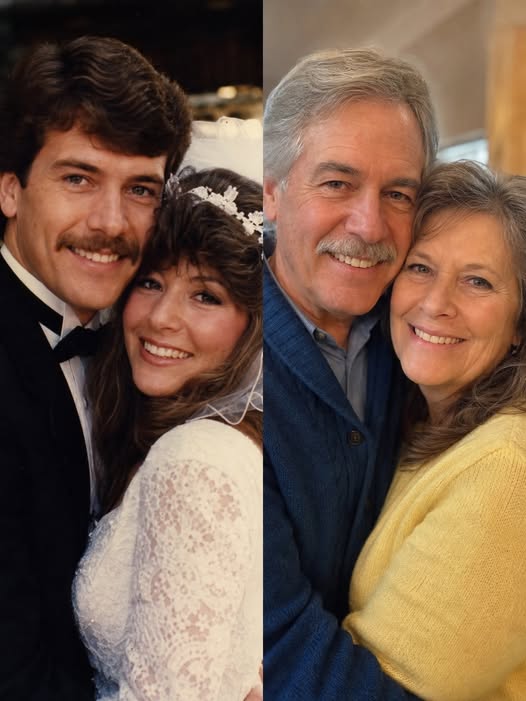
I thought I had already mourned my husband five years earlier—not in a church or beside a coffin, but in the quiet aftermath of his confession.
Thirty-eight years of marriage ended in a single moment when Richard told me he had been unfaithful. He stood in our kitchen, unable to look at me, and dismantled everything we had built together with a few strained sentences. By the time he left with two suitcases and a life I no longer recognized, I felt as if he had already died in my world.
So when the hospital called years later to say he had passed away from a heart attack, my first reaction wasn’t devastation.
It was emptiness.
At the funeral, people expected grief from me, but I had already spent years living inside it. I went only to confirm to myself that I had survived him—the betrayal, the silence that followed, and the long, slow rebuilding of a life that no longer included him.
I wore black, kept my expression steady, and told myself I was fine.
That certainty held until I noticed a woman standing alone at the back of the chapel.
She wasn’t what I had once imagined “the other woman” would look like. No arrogance. No satisfaction. Just unease, as if she didn’t belong there at all.
After the service, she approached me carefully.
“You’re Julia, right?” she asked.
When I nodded, she hesitated before saying, “There are things about Richard you never knew.”
I almost walked away. But something in her voice stopped me.
Her name was Elise. And what she said next didn’t match the story I had carried for five years.
There had been no affair—not in the way I believed. Instead, she spoke of a diagnosis. A degenerative illness. Terminal. The kind that slowly takes everything from a person.
Richard had known. And he never told me.
Instead, he chose to end our marriage by giving me a version of him I could hate.
A betrayal was easier to survive than watching him disappear.
At first, I refused to believe her. It felt too convenient, too late. But then she handed me a letter—my name written in his handwriting.
Inside, Richard confessed everything: the illness, the fear, and the reason behind his silence. He believed that if I knew the truth, I would stay. I would watch him decline. I would lose him slowly instead of all at once.
And he couldn’t bear to let me carry that.
So he made himself the villain.
Reading his words shattered the version of grief I had carefully built. For five years I had mourned a man who left me for someone else. Now I realized I had also been mourning a man who left to protect me from watching him die.
Neither version made the truth easier.
He took away my choice—my right to decide whether I could have stayed, loved, and endured the end alongside him. That loss cut deeper than the betrayal ever had.
Richard tried to spare me pain, but in doing so, he created a different kind of wound. One built from absence, confusion, and time I can never get back.
Now I carry both truths at once: the man who broke me, and the man who loved me enough to disappear.
And somehow, I have to learn how to live with both.
Leave a Reply