
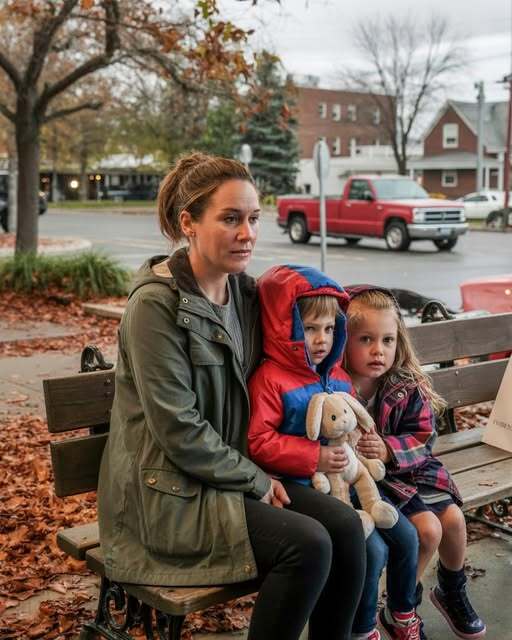
The last thing I expected to notice was a faint red pulse glowing from the torn ear of my daughter’s stuffed rabbit.
For nine days, my girls and I had been surviving out of a cramped sedan, hiding in parking lots, sharing cheap snacks in silence, and jumping every time headlights slowed nearby. Ever since the morning I fled my husband after he grabbed my wrist hard enough to bruise and told me I “wasn’t going anywhere,” fear had followed us like a shadow. I took only what I could carry — my daughters, a few clothes, emergency cash, and the desperate belief that if we stayed quiet enough, invisible enough, he would eventually stop looking.
I couldn’t have been more wrong.
That cold November afternoon, my daughters were pressed against me on a park bench trying to stay warm when an older woman sat several feet away. Her name was Denise Harlan. She had silver hair, tired but kind eyes, and the calm presence of someone who had spent years helping people through terrible moments. I didn’t know then that she had once worked as a school counselor and now volunteered helping women escaping abusive homes.
What I noticed first was how safe she felt.
She gently pointed out that my daughter’s shoelace was untied even though it wasn’t. Looking back, I think she was testing whether I would panic or lash out from fear. When I answered politely, she offered to let us warm up inside the nearby nature center.
I almost refused.
By that point, fear had taught me to distrust everyone.
Then Ruthie lifted her stuffed rabbit and quietly said, “Mommy… Bunny has a red light.”
I looked down and saw it instantly.
A tiny blinking glow pulsing beneath the ripped fabric of the rabbit’s ear.
My entire body went cold.
At the same moment, the red pickup truck I’d noticed circling the parking lot suddenly stopped feeling like coincidence.
It was him.
He’d been tracking us.
Denise understood immediately. She didn’t question me or try to explain it away. She stood up calmly, told my daughters to stay close, and guided us through a side entrance into the nature center while pulling out her phone. Her voice stayed steady as she spoke quietly to someone on the other end, and for the first time in days, I felt like somebody else understood the danger we were in.
Inside a small office, Denise locked the door and crouched beside Ruthie.
“Can I borrow Bunny for one second?” she asked gently.
Using tiny scissors from her keychain, she carefully opened the seam in the rabbit’s ear and pulled apart the stuffing until a small tracking device dropped into her palm.
I stared at it in disbelief.
Proof that my husband had never lost us.
Proof that every “coincidence” over the last week hadn’t been coincidence at all.
Instead of throwing the tracker away, Denise placed it inside a lost-and-found bin and asked another employee to move it across the property. Whoever was following the signal would head the wrong direction.
That moment changed something inside me.
I had spent days believing survival meant becoming invisible. But Denise made me realize there’s a difference between hiding from danger and hiding from help.
She looked directly at me and asked softly, “Do you want us to help you, Shelby?”
Not “What did you do?” Not “Why didn’t you leave sooner?”
Just a question that gave me control over my own life again.
I finally said yes.
That night, my daughters and I arrived at a women’s shelter inside an old brick building that smelled like detergent and coffee. For the first time in years, I slept somewhere my husband couldn’t enter.
Over the next several days, I told my story piece by piece. I explained how Trent had slowly isolated me after my mother died, how his affection gradually became control, then intimidation, then violence. I described the holes punched into walls beside my head, the broken dishes, the apologies that always came after the damage was done.
A legal advocate named Mireya helped me organize everything — threatening messages, financial control, patterns of manipulation. She showed me that abuse wasn’t only bruises. It was systematic fear.
But the final piece of evidence came from my oldest daughter, Hadley.
Months earlier, she’d started using an old school tablet to take random photos and videos of clouds, birds, and rainstorms. On the morning we fled, she had accidentally recorded an argument between Trent and me.
The audio captured his voice clearly.
Calm. Controlled. Threatening.
“You want the girls to see what happens when you stop listening?”
That recording became the evidence we needed in court.
For years, I thought silence protected us.
Instead, silence protected him.
The moment I stopped hiding the truth, everything began to change.
My daughter noticed a blinking light inside a stuffed rabbit and unknowingly exposed the man hunting us. That tiny moment gave us enough time to escape, enough proof to fight back, and enough hope to finally imagine a future beyond fear.
For the first time in a very long time, we weren’t surviving in the dark anymore.
Leave a Reply