
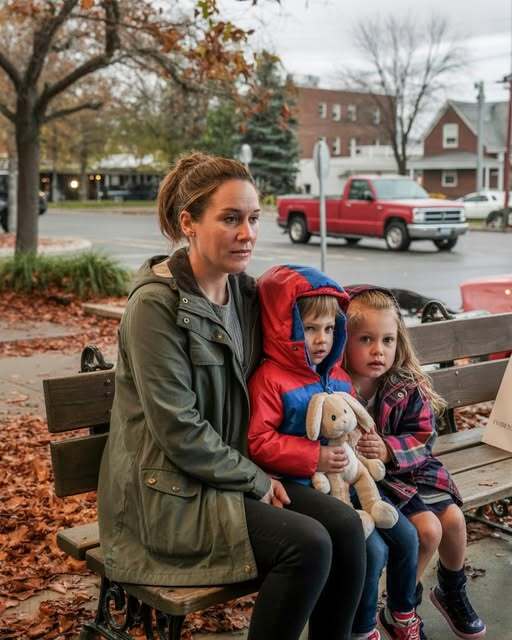
The last thing I expected to see was a worn stuffed rabbit with something hidden inside its ear—something that pulsed with a faint, unnatural red light.
My two daughters and I had spent nine days drifting in survival mode after fleeing my husband. We slept in the front seats of an old car when we could, ate cheap snacks in parking lots, and startled at every passing engine like it meant we’d been found. I left after a moment I couldn’t ignore anymore—when my husband grabbed my wrist and told me, flatly, that I wasn’t allowed to leave. So I did the only thing I could think to do: I waited for a morning when I could slip away with the girls, an emergency bag, and a few folded bills, hoping we could simply vanish into a world that didn’t look too closely at people like us.
I told myself invisibility was survival. If I stayed quiet enough, small enough, maybe we could disappear before he noticed we were gone.
I was wrong about a lot of things.
We were sitting on a cold park bench in November, trying to share warmth between us, when a woman named Denise Harlan sat down at the far end. She had the calm presence of someone used to crisis—steady, unhurried, observant. I didn’t know then that she had spent years working as an ER nurse and supporting families escaping unsafe homes. All I knew was that she looked at us in a way that didn’t feel like judgment or curiosity, but recognition.
She noticed the details most people would miss. The way I kept scanning the parking lot. The way my oldest daughter flinched at sudden sounds. The way my youngest clutched a worn stuffed rabbit like it was the only stable thing in her world.
Denise made a gentle comment about my daughter’s shoe being untied. It seemed small, almost ordinary, but I understand now it was a way of seeing whether I could respond, whether I was still present enough to accept help.
When I hesitated, she offered us a warm place to sit inside the nearby nature center. I was on the edge of refusing—fear makes even kindness feel like a trap—when my youngest lifted her rabbit and said, almost casually, “Mommy… Bunny has a light.”
I looked down.
And my stomach dropped.
A faint red pulse was blinking inside the rabbit’s ear.
Not a reflection. Not a trick of fabric.
A signal.
My attention snapped outward at the same moment, and everything I had been trying not to notice came into focus: a red pickup truck that had been lingering at the edge of the road, too still for too long, like it was waiting for confirmation.
Denise didn’t freeze. She didn’t question me or try to minimize it. She stood up immediately, calm and decisive, and guided us inside with a quiet urgency that made it clear she understood far more than she was saying.
Once inside, she moved with practiced speed—closing doors, making calls, positioning us somewhere out of sight. Then she carefully examined the rabbit, her hands steady even as mine weren’t.
Inside the seam, she found it: a small tracking device embedded deep in the stuffing.
She didn’t throw it away where it could be recovered. She redirected it, placing it where it would mislead anyone trying to follow its signal, then turned to me and asked simply, “Do you want help?”
It wasn’t dramatic. It was worse than that—simple enough that I had no excuse to refuse.
That question broke something open in me.
We were moved to a shelter built for moments like this, the kind of place that looks ordinary from the outside but holds the weight of too many stories like mine. There, I finally started to put my life into words. Denise stayed beside me while I wrote everything down—how isolation had started quietly, how control replaced connection, how my world slowly narrowed until leaving felt impossible.
A legal advocate helped me turn fragmented memories into evidence. Patterns I had once dismissed as “just how things were” became something else entirely when written down together. Messages. Control. Escalation.
And then there was my daughter.
She had unknowingly captured what I couldn’t: a short audio recording on a broken tablet during one of his outbursts. His voice, calm and certain, turned into something undeniable when played back. It wasn’t just anger—it was intent, spoken without hesitation.
That recording became the turning point.
In court, it wasn’t just my word against his anymore. It was a pattern that could be seen, heard, and understood.
And as everything finally came into focus, I realized something that took me too long to learn:
We didn’t survive because we were invisible.
We survived because, at the exact right moment, someone noticed.
Leave a Reply