
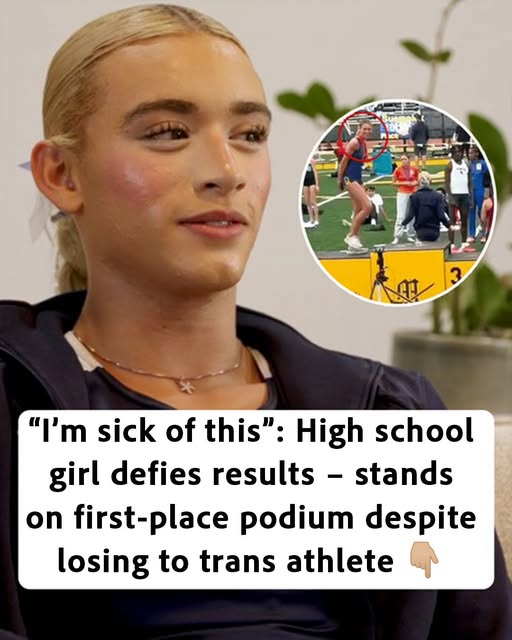
The stadium fell into an uneasy silence as she stepped toward the podium. Thousands sat under the bright California sun, yet for a few suspended seconds, the usual noise of the meet vanished. No cheering. No whistles. Only the clicks of cameras as teenage athlete Reese Hogan walked toward the first-place spot she felt should have been hers.
She didn’t scream. She didn’t wave a protest sign or give a fiery speech. That restraint made the moment even more powerful. Quiet defiance can unsettle more than anger ever does. Reese simply stood there, shoulders tense, jaw tight, claiming a symbolic space after finishing behind a transgender competitor—a performance that reignited one of the most divisive debates in modern sports.
Within hours, footage of the moment went viral. Millions watched, each side seeing something different. Some called Reese brave, a young woman standing up for fairness in female athletics. Others called the act cruel, turning another teenager into a public target for simply competing. The internet, as it often does with emotionally charged moments, flattened people into symbols and demanded immediate judgment.
But the moment on that podium was never just about one teenager.
It was the collision of two fears society struggles to hold at once.
On one side are girls and women who have trained for years in sports designed around protected female competition. Many fear that opportunities, scholarships, records, and hard-earned victories could gradually vanish if biological differences are ignored. For them, this debate is personal—built on early mornings, injuries, sacrifices, and dreams measured in fractions of a second or inches.
On the other side are transgender athletes, many of them teenagers, trying to exist in spaces where their very identities are contested. They’re told, implicitly or explicitly, that their participation is unfair, dangerous, or unwelcome. Imagine navigating high school while millions of strangers argue over whether your existence threatens someone else’s future.
Both sides carry real pain. Both carry fear. And both are trapped in a conversation that rewards outrage over understanding.
The cameras captured Reese on the podium, but they didn’t show the years behind that moment. They didn’t show dawn practices, stress fractures, exhausted parents driving to competitions, or teenage athletes crying in private after disappointment. They didn’t show coaches wrestling with policies they may not fully agree with, or parents lying awake at night trying to reconcile two instincts that feel impossible to hold at once: protecting fairness for their daughters while teaching compassion to vulnerable kids.
What makes this issue explosive is that both values—fair competition and human dignity—matter deeply. Yet public debate often frames empathy as betrayal. Concern for fairness is labeled cruelty. Compassion for transgender athletes is accused of ignoring biology. The nuanced middle ground, where most people actually live, is drowned out by shouting.
Meanwhile, the athletes themselves absorb the fallout. Teenagers become national talking points overnight. Their faces appear endlessly online beside headlines designed to provoke anger. Strangers dissect their bodies, motives, identities, and emotions as if they were political objects rather than young people figuring out who they are. That kind of attention can permanently change a life—especially at an age when identity is fragile.
This debate won’t be solved by a viral clip, a protest, a championship, or a single law. Sports organizations, scientists, lawmakers, parents, and athletes are all still wrestling with questions of biology, fairness, inclusion, and identity. Pretending it’s simple only deepens the divide.
Yet there is a harder path—one requiring honesty without dehumanization. A path where biological differences can be acknowledged without vilifying transgender individuals; where compassion and fairness coexist.
Because behind every podium is still a person.
A teenager with pre-competition nerves. A family in the stands. A coach offering encouragement. A kid hoping years of work mattered. Long before the cameras arrived, these were simply young athletes seeking belonging, purpose, and pride in the arenas they loved.
If society forgets their humanity in the midst of cultural battles, everyone standing on that podium loses something far greater than first place.
Leave a Reply