
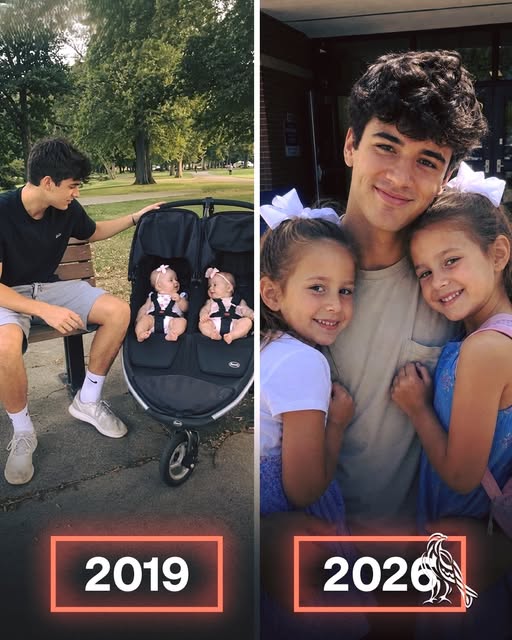
I never expected to become a parent before I was even old enough to legally drink. At eighteen, I was supposed to be finishing school, thinking about college, and slowly figuring out my future. Instead, I was in a small apartment at three in the morning, holding one crying newborn while another screamed from a bassinet beside me—both completely dependent on me. My mother was gone. No note, no warning, just silence. And that silence reshaped everything.
My mother, Lorraine, had always been unstable in ways I couldn’t fully understand. One moment she was affectionate and present, the next she was distant and unpredictable, like she was constantly fighting something inside herself. When she became pregnant with twins, I thought maybe things would finally change. I believed motherhood might ground her. It didn’t. If anything, she became more withdrawn, more erratic, more unreachable. She never told me who the father was, and any questions about it ended in anger.
When Ava and Ellen were born, there were brief flashes of effort. For a couple of weeks, she tried—feeding them, holding them, attempting some kind of routine. But it didn’t last. She started disappearing into her room for hours, leaving me to handle everything while still trying to finish high school. I studied between feedings, survived on almost no sleep, and slowly realized I was carrying more than I was ever prepared for.
Then one night, it all fell apart. I woke to crying, but the house felt wrong—too quiet in the places she should have been. Her coat was gone. So was she. That was the moment it became clear there was no one else coming. If I didn’t step up, the twins would have no one at all.
I abandoned my college plans that same week. I had once dreamed of becoming a surgeon, something that had felt real and possible when I was younger. But that version of life disappeared almost overnight. My days became work, bottles, diapers, and exhaustion. I took any job I could find—warehouse shifts, deliveries, stocking shelves at night—anything that kept us afloat.
I learned how to stretch every dollar, how to function on very little sleep, and how to care for two babies at once without falling apart. People told me I was too young for this, that the system should take over, that I deserved my own life. But every time I considered letting go, I saw two girls growing up without anyone who truly stayed.
So I stayed.
Eventually, they started calling me “Bubba.” It began as a childish mispronunciation, but it stuck. Everyone used it—teachers, neighbors, even me eventually. It became part of our identity. We built a life around small routines: pancakes on weekends, movie nights, homework at the kitchen table, drawings on the fridge signed “Me, Ellen, Ava, and Bubba.” It wasn’t conventional, but it was steady.
For years, that was our world. Until Lorraine returned.
Seven years later, she reappeared as if nothing had happened. At first, I barely recognized her—polished, composed, dressed like someone who belonged to a completely different life. Expensive clothes, perfect makeup, controlled confidence. But the moment she heard the girls, she shifted instantly, like she could step back into a role she had abandoned long ago.
She arrived with gifts—bags of clothes, electronics, toys—trying to bridge seven years in a single gesture. The girls were curious, even excited at first, because children naturally want connection. I tried not to react too quickly, but something about it felt staged. Not like returning. Like performing.
Then the legal papers came.
Custody filings. Guardianship requests. Official documents that made her intentions impossible to ignore. I read them in disbelief. This wasn’t just a visit or reconciliation attempt—she was trying to take them back. When I confronted her, she didn’t deny it. She said she could now provide a better life, more stability, more opportunity. She didn’t say she missed them. She said she needed them.
That word stayed with me.
Everything shifted when the girls came home early and walked straight into the argument. They heard enough. Ava started crying immediately. Ellen froze, trying to understand what she was hearing. Then Ellen said quietly, “You left us.” And Ava followed with, “Bubba stayed.”
That was the end of any illusion.
They came to me without hesitation. Ava clung to me crying, and Ellen said something I’ll never forget: “You’re our real parent.” Lorraine didn’t respond the way I expected. There was no apology, only frustration—like reality wasn’t cooperating with her version of the story. Before leaving, she said I would regret it. Then she walked out.
After that, I stopped reacting emotionally and started preparing practically. I got a lawyer, filed for guardianship, and documented everything. Not out of revenge, but because the situation needed structure in a system that only responds to proof. School records, medical forms, teacher statements, neighbors—everything showed the same reality: I had been their parent in every meaningful way.
In court, Lorraine’s side tried to question my stability. But the evidence was overwhelming. When the judge spoke privately with the girls, their choice was immediate and clear.
The ruling granted me full guardianship. Lorraine was ordered to pay child support. No dramatic moment followed—just a quiet legal ending that finally made things secure.
Life changed after that. I was able to cut back on work. I slept more. I cooked meals without rushing. Slowly, I started thinking about myself again in a way I hadn’t allowed in years.
At night, after the girls were asleep, I began looking at college programs again. Nursing. Science. Pre-med. The future I once buried didn’t feel impossible anymore. One evening, Ellen saw the application page and asked if it was “doctor school.” I said maybe. She nodded and said, “You’ll do it. You always do.” Ava added, “We’ll help you now.”
That was the first time in a long time I felt something like relief.
Now I’m twenty-five. Life is still busy, still imperfect, but it’s stable. I work part-time, study at night, and raise two girls who feel less like dependents and more like teammates in survival. Lorraine hasn’t returned, except for the required payments.
I don’t need answers from her anymore. I don’t need closure from the past to keep moving forward. The girls already have what mattered most: someone who stayed.
And I’ve started to understand something I didn’t see back then.
Staying didn’t just hold our lives together.
It gave me one too.
Leave a Reply