
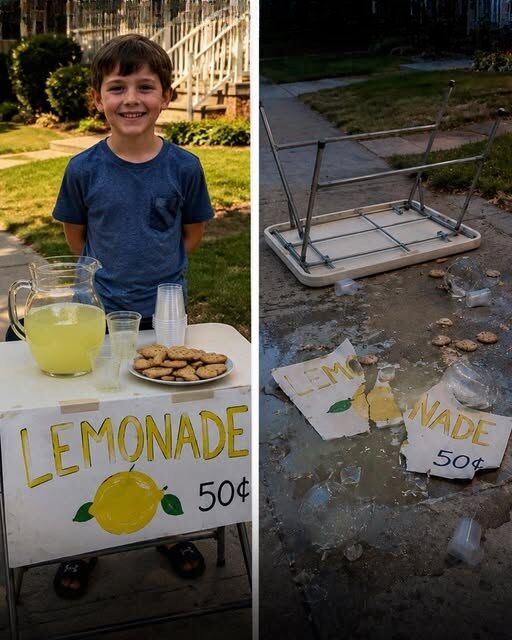
I was convinced I’d met the coldest man on our entire block the day our neighbor knocked over my eight-year-old son’s lemonade stand. By the next afternoon, that same man was standing on our porch in tears—and somehow, my son was at the center of it all.
Noah changed after his father died last year.
He started “helping” in ways no child should feel responsible for. Carrying groceries before I could ask, taking out trash from neighbors, asking about bills he didn’t need to understand. He even kept a small blue biscuit tin above the fridge where he saved every dollar anyone ever gave him.
He called it his “house money.”
Every Sunday, he’d proudly bring it to me.
And every time, I’d gently push it back. “Sweetheart, this isn’t your job.”
He’d just shrug. “I’m still helping you.”
Last week, I found him staring at our broken washing machine again. Before I could say anything, he placed a drawing on the kitchen table: a new washer beside a lemonade stand.
“Mom,” he said, serious as ever, “I’m going to sell lemonade and buy you a new one.”
I tried to tell him he didn’t need to carry that weight. He just looked up at me and said, “It’s our washer.”
So that Saturday, we built the stand together.
A folding table. Handwritten signs. Plastic cups. Noah insisted we needed “inventory,” so I baked cookies. He wore his cap backward like he was running a real business.
And for a while, it worked.
Neighbors stopped by. They bought lemonade, left tips, complimented him like he was the hardest-working kid on the block. I saw him laugh more that day than I had in months.
Then I stepped inside for less than two minutes.
When I came back out, Mr. Peterson was already there.
He lived across the street—older, always complaining, always unhappy with something.
“This is blocking the sidewalk,” he snapped.
Noah tried to move immediately. “I can fix it—”
But he didn’t let him finish.
Mr. Peterson grabbed the table and shoved it.
Everything collapsed at once—lemonade spilling, cookies scattering, coins rolling across the pavement, Noah’s sign tearing right down the middle.
My son just stood there, completely still.
“Learn some respect,” he said, before walking away.
That night, Noah stared at the broken pieces and whispered, “The washer money…”
I held him while he cried.
The police came. They gave Mr. Peterson a warning. Nothing more.
Noah didn’t talk much after that.
Until the next morning, when he said something that unsettled me in a different way.
“It’s okay, Mom. I’ll handle it.”
I told him firmly that adults don’t get “fixed” by children.
He just nodded. “I know. But I can still help.”
I should’ve known he wouldn’t drop it.
Because the next morning, a group of kids from the neighborhood showed up outside. Noah was with them, focused, determined.
“Don’t worry, Mom,” he called out. “We have a mission.”
Forty minutes later, someone was pounding on our door.
When I opened it, I froze.
Mr. Peterson was standing there—crying.
“Please,” he said, voice shaking. “Tell them to stop.”
I rushed outside.
And what I saw didn’t make sense at first.
Across the street, Noah and the other kids were carefully cleaning up Mr. Peterson’s yard. The old flagpole had been repainted. Weeds were gone. A new flag moved in the wind. A handmade banner hung near the porch:
“THANK YOU FOR YOUR SERVICE. HEROES DESERVE KINDNESS.”
I turned to Noah. “What is this?”
He looked calm. “His yard looked lonely.”
Then, after a pause: “Like him.”
Mr. Peterson broke down right there.
He told us his wife used to raise that flag every morning. After she passed, he stopped. He stopped a lot of things after that—including, he admitted quietly, how to be kind.
Noah just listened.
Then he said, simply, “You don’t have to stay that way.”
Something in that broke through.
The next day, Mr. Peterson showed up with wood, nails, and two pie tins.
“I owe an apology,” he said. “And maybe… a business plan.”
By midday, they were building a new lemonade stand together—better than the first one.
Neighbors started coming again. Mr. Peterson brought pies this time. Noah laughed again, really laughed, like the weight he’d been carrying had finally loosened.
“If we keep this up,” Mr. Peterson said once, glancing over, “we’ll get your mom that washer before summer.”
Noah grinned. “Then we’re partners.”
And as I stood there watching them, I realized something simple but heavy:
The washing machine wasn’t the thing that needed fixing in our home.
Leave a Reply