
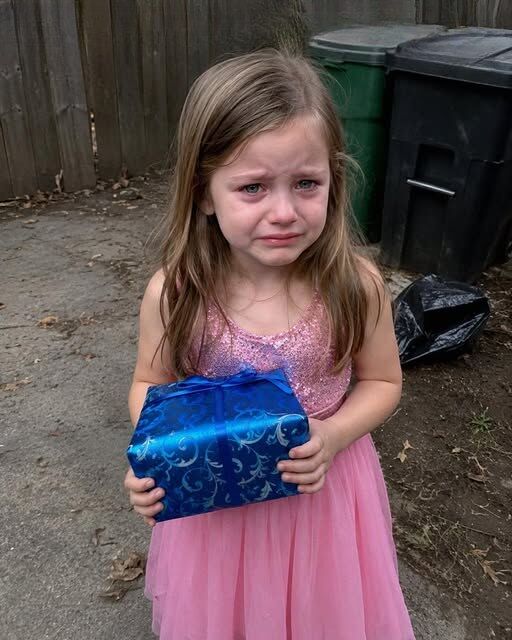
Tina’s silence finally broke the moment her young daughter was left crying at a family gathering. What followed wasn’t just a confrontation, but a clash rooted in one mother’s promise: that no one would ever decide who belongs in her child’s life or heart.
When I first met Daniel, I was 28—divorced, and already a mother.
Ellie was just two when she came along on our first date. It wasn’t planned as a “test,” but it became one anyway. I needed to know whether this man could accept every part of my world, including her.
Most people tried to act polite. Forced smiles, awkward small talk.
But Daniel didn’t.
While I watched from a booth with cold fries in front of me, he got down on her level, noticed her rabbit socks, and spent nearly twenty minutes helping her glue sequins onto paper. No performance. No hesitation.
Two years later, we married in a small ceremony. Ellie, wearing a flower crown, insisted on standing between us and holding both our hands. At one point, she even stood up mid-celebration with frosting on her face to make a toast.
“He’s my almost-daddy,” she announced.
Daniel cried when everyone laughed.
On her fifth birthday, he officially adopted her. We celebrated in the backyard with lights, cake, and laughter. She stayed pressed against him long after the party ended.
“Can I call you Dad for real now?” she asked softly.
“Only if I get to be your dad forever,” he answered.
I remember thinking that love like that could fix anything.
But I’ve since learned something harder: not every heart expands with kindness.
Carol, my mother-in-law, was never openly cruel. She simply… excluded. Subtle things at first. Ignoring Ellie’s drawings. Cold acknowledgments. Cards addressed only to “Daniel and Tina,” even after the adoption.
Once, over dinner, she looked me over and said, “You had to grow up fast, being a single mother.”
Daniel brushed it off. “She just needs time.”
So I gave her time—until the day she crossed a line I couldn’t ignore.
It was a Saturday afternoon. Jason, my nephew, was celebrating his seventh birthday with a Pokémon-themed party.
Ellie was thrilled. She picked out a gift carefully, worrying for days about whether Jason would like it. When she finally chose a rare Pokémon card set, she wrapped it like it was something precious.
That morning, she wore her favorite sparkly dress and smiled, saying she wanted to “look nice for pictures.”
We dropped her off with hugs and promises to return soon.
Less than an hour later, my phone rang.
Ellie.
She was crying so hard she could barely speak.
“Mom… Grandma said I have to leave… I’m in the backyard,” she sobbed.
We rushed back immediately.
She was outside by the fence, clutching her gift like a shield, her dress stained, her face red and tear-streaked.
Daniel dropped to his knees instantly and pulled her into his arms.
I didn’t stop—I went straight inside.
Carol was sitting at the table eating cake, calm, composed, as if nothing had happened.
“Why is my daughter outside?” I demanded.
The room went quiet.
Carol didn’t even look up. “Ellie isn’t family,” she said flatly. “Only family was invited.”
The air left the room.
Sarah, my sister-in-law, avoided my eyes. “We didn’t want to ruin Jason’s party… we thought it would be easier.”
That was the moment everything in me snapped.
“She’s six years old,” I said. “And you let her sit outside alone so you could keep eating cake?”
I didn’t stay long after that. If I had, I wouldn’t have trusted myself to stop.
Outside, Ellie clung to Daniel the entire ride home, like he was the only solid thing in the world.
At home, we did the only thing that mattered: we made sure she felt safe again.
Ice cream. A movie she chose. A couch piled with blankets. Slowly, her breathing evened out as she fell asleep between us.
But something had changed.
“I’m not letting this go,” I told Daniel.
He didn’t hesitate. “Neither am I.”
Two weeks later, we hosted a birthday lunch for Daniel at our home. The invitation was simple:
A celebration for Daniel—and for the people who truly consider Ellie family.
Carol texted almost immediately.
“Are you excluding me on purpose?”
I replied honestly: “I’m just following the same rules you set. Family only.”
She didn’t respond.
The day itself felt different. Warm, open, intentional. Not a performance—just people who chose to be there.
Jason arrived with Mark, and the moment he saw Ellie, he walked straight to her.
“I told Grandma she was wrong,” he said. “You’re my sister.”
Ellie blinked at him, surprised, then ran inside without a word.
When she came back, she was holding the same gold-wrapped gift she had brought to the party two weeks earlier.
“I saved it for you,” she told Jason. “It still belongs to you.”
Jason held it like it was something priceless.
The rest of the afternoon felt lighter than anything we’d had in a long time—laughter, music, kids running through the yard as the sun went down.
That night, I posted a single photo of Ellie and Jason sitting together, smiling.
The caption read:
“Family is who shows up with love—not just blood.”
A few weeks later, Carol called.
Ellie answered first.
“Hi Grandma,” she said quietly, then listened for a moment.
“I forgive you… but don’t do that again,” she added simply, then handed me the phone.
Carol apologized.
And Daniel later told her something I didn’t know he’d said: that if she couldn’t accept Ellie, she would lose him too.
Since then, things have shifted. Carefully. Imperfectly.
Carol sends cards now—stickers, cats, bright colors. She asks about Ellie’s day, her snacks, her interests.
I don’t forget what happened.
But Ellie seems to.
One afternoon, she looked up from her dolls and said, “I think Grandma is trying.”
And maybe that’s true.
But what matters most is simpler than forgiveness or change.
Ellie will never have to wonder if she belongs again—not in this home, not in this family, and not in herself.
Leave a Reply