
Fifty Riders Stood Between Us and the Noise: A Story of Grief, Dignity, and Unexpected Kindness
It was a quiet Tuesday morning—the kind that should have slipped by unnoticed. But for me, time had already fractured.
I was kneeling beside my son Daniel’s casket, my hands resting on the polished wood as if touch alone could bridge the distance between us. He was twenty-four. No parent prepares for that kind of goodbye, and yet there I was, facing a reality that didn’t feel real.
Everything around me seemed slowed, softened. The trees barely moved in the wind, and the cemetery felt distant, almost unreal, like the world had muted itself out of respect. My husband Earl stood close, his hand hovering near my shoulder, steadying me without quite touching. The chaplain spoke gently, carefully choosing words meant to comfort, but grief has a way of narrowing everything until only loss remains.
I tried to listen. I really did. But all I could hear was Daniel—his voice, his laugh, the small everyday moments that suddenly felt immense in their absence. Twenty-four years felt like nothing and everything at the same time.
And then the interruption came.
At first, it was just faint noise from beyond the road. Raised voices. Out of place, but distant enough that I hoped it would fade. It didn’t.
It grew louder.
Sharp. Disruptive. Wrong for a place meant for farewell. Earl shifted closer, as if he could physically block it from reaching me. The chaplain paused, then continued, though his expression tightened.
But some sounds don’t stay outside. They seep in anyway.
I closed my eyes, not in anger, but in disbelief. Even here, even now?
Grief already felt unbearable. This felt like something added on top of it, something no one should have to carry.
Then came another sound.
Low at first. A rumble in the distance. Not chaotic like the shouting, but steady—intentional. Engines.
I opened my eyes.
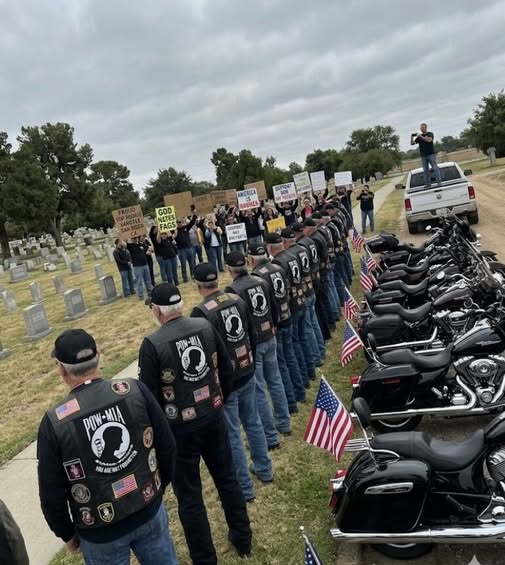
Motorcycles began to enter the cemetery.
There were many of them—far more than I could immediately count. I would later learn it was around fifty riders, but in that moment, it was simply a wave of presence arriving all at once.
They didn’t rush. They didn’t rev engines or draw attention. They moved with purpose, forming a line between the funeral and the source of the disturbance.
One by one, they parked. One by one, they stepped off their bikes.
And just like that, they became a barrier—not aggressive, not confrontational, but unmistakably present.
The noise across the road continued for a moment, but something had shifted. It no longer reached us in the same way. The riders didn’t argue or escalate anything. They simply stood there, creating space where there had been none.
At one point, someone tried to keep the disruption going, raising their voice again. An older rider stepped forward alone toward the boundary.
He didn’t rush. He didn’t posture.
He spoke calmly.
I couldn’t hear every word from where I was, but I later learned he had buried his own son years before. What he said wasn’t a threat or a demand—it was a boundary born from experience. A reminder that grief deserves dignity, not interference.
After that, the energy changed. The voices faded. One by one, the disruption dissolved until only silence remained.
But this time, it was a protected silence.
The service continued as it should have from the beginning. The chaplain’s words carried clearly. The ceremony unfolded without interruption. The space felt whole again.
The riders remained, standing quietly. When the bugle played, they removed their helmets and placed their hands over their hearts. No one asked them to. They simply did it.
When I received the folded flag, my hands shook. That moment will never leave me.
One of the riders—an older man who would later introduce himself as “Doc”—gave me a small nod. Not dramatic. Not performative. Just acknowledgment.
A quiet message: I see you.
Afterward, they didn’t simply leave. They escorted the procession, riding alongside us as we departed. People along the streets stood silently, some with hands over their hearts. It felt as if the entire world had briefly agreed to be still.
Later, Doc gave me an envelope. He didn’t explain much, only said I could open it when I was ready.
Days later, I did.
Inside was a list of fifty names—each rider who had been there. Next to each was another name, someone they had lost or carried with them in memory. Sons, daughters, friends, family.
At the bottom, Doc had added Daniel’s name.
A note explained simply that Daniel would be remembered among them now—that he would ride with them in spirit, alongside others they honored.
I sat with that paper for a long time.
It didn’t erase grief. Nothing could.
But it softened its isolation.
It reminded me that loss, while deeply personal, is never entirely solitary.
Months passed. The grief didn’t disappear, but it changed shape. It became something I learned to live beside rather than something that consumed me entirely.
Then I received a message from Doc.
Another funeral. Another young Marine. Another family about to face the same kind of day I remembered too clearly.
He asked if I would come—not as someone who had answers, but as someone who understood.
I wasn’t sure at first. Reliving that kind of day wasn’t easy. But I remembered what it felt like to not be alone in it.
So I went.
At the service, I saw her—the young Marine’s mother. Her expression carried the same disbelief I once wore.
I didn’t try to fix anything. I simply stood beside her and held her hands.
No perfect words. No explanations. Just presence.
And I understood then what had stayed with me all this time.
Grief doesn’t end.
But it can be shared in ways that make it less isolating.
The riders continued their work quietly over time—showing up, standing watch, making space for families who needed dignity in the hardest moments of their lives.
They never called themselves heroes.
They didn’t need to.
They simply arrived when it mattered.
And for me, that Tuesday morning will always be one of the hardest days of my life.
But it will also always be the day I learned that even in the deepest grief, there are people willing to stand between you and the world’s noise—just long enough for you to say goodbye.
Leave a Reply