
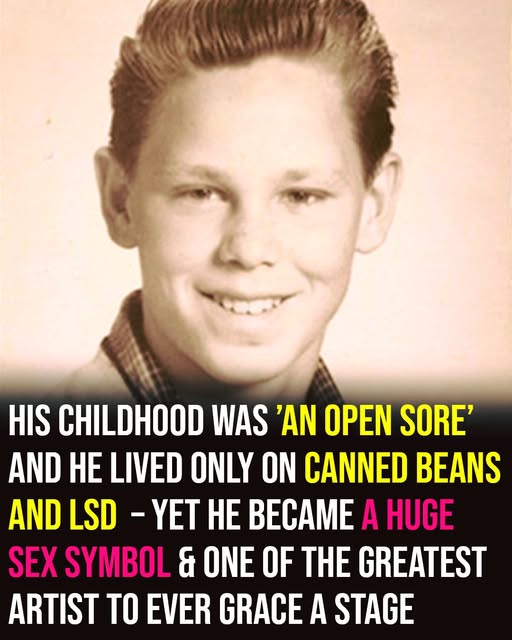
Few artists in rock history have left a cultural footprint as enduring as Jim Morrison, the frontman of The Doors. Recognized for his deep vocal tone, poetic lyricism, and unpredictable stage energy, he emerged as one of the defining figures of 1960s rock. His performances often blurred the line between music and spoken-word poetry, setting him apart from many of his peers.
Born on December 8, 1943, in Melbourne, Florida, Morrison was raised in a military household. His father, George Stephen Morrison, served as a U.S. Navy rear admiral and was later connected to events surrounding the Gulf of Tonkin during the Vietnam era. Due to his father’s naval career, Morrison spent much of his childhood moving between different locations across the United States, experiencing frequent change and instability.
Throughout his early education, he attended multiple schools, an experience that contributed to his restless and shifting outlook on life. He eventually enrolled at the University of California, Los Angeles (UCLA), where he studied film. While there, he developed a growing interest in poetry and experimental art, which later became central to his songwriting style.
One commonly referenced moment from his youth involves a road trip in which his family reportedly came across the aftermath of a serious car accident in the American Southwest. Morrison later described this event in highly symbolic, almost mythic language in interviews and writings. However, family members have suggested that while the incident did occur, his later retellings were likely shaped more by artistic interpretation than literal memory.
After leaving UCLA, Morrison moved to Venice Beach, California, where he immersed himself in a bohemian lifestyle focused on writing and creative exploration. It was during this period that he met Ray Manzarek, also a UCLA student. Together, they laid the groundwork for what would become The Doors, later joined by Robby Krieger and John Densmore.
The band’s name was inspired by Aldous Huxley’s The Doors of Perception, itself referencing William Blake’s idea that perception can open “doors” to new realities. This concept reflected the band’s artistic direction, which blended rock, blues, and psychedelic influences into a distinct sound.
By 1967, The Doors had achieved major commercial success, most notably with “Light My Fire,” which topped the Billboard charts. Their debut album helped define the sound of psychedelic rock and established Morrison as a compelling and unconventional frontman. His lyrics frequently explored themes such as freedom, mortality, philosophy, and altered states of consciousness.
As their popularity grew, Morrison’s stage behavior became increasingly intense and unpredictable. His performances often carried a raw emotional force that captivated audiences but also created controversy. This duality helped cement his reputation as a symbol of rebellion during the counterculture movement of the 1960s.
Offstage, he struggled with heavy alcohol use, which gradually affected his personal stability and professional consistency. Those close to the band later recalled difficulties during recording sessions, including erratic attendance and challenges maintaining focus.
Despite these issues, The Doors continued releasing influential albums such as Strange Days, Waiting for the Sun, The Soft Parade, Morrison Hotel, and L.A. Woman. These records remain significant in rock history for their lyrical ambition and experimental sound.
Morrison also encountered legal troubles during his career, most famously stemming from a 1969 Miami concert incident that led to charges related to indecent exposure and disorderly conduct. While he denied parts of the accusations, the case became a defining moment in his public image and remains debated to this day.
His personal life was equally complex, particularly his long-term relationship with Pamela Courson. Their connection was deeply emotional but often unstable, reflecting the turbulence that characterized much of his life.
By the early 1970s, Morrison stepped away from music to focus on poetry and writing. He relocated to Paris in 1971, seeking distance from fame and a quieter environment for creative work.
On July 3, 1971, he was found dead in a bathtub in his Paris apartment at the age of 27. No autopsy was conducted under French law at the time, and the official cause of death was recorded as heart failure. The absence of medical examination has led to ongoing speculation, though no definitive alternative explanation has ever been confirmed.
His passing placed him among the group of influential musicians often referred to as the “27 Club.” Over time, Morrison’s legacy has grown beyond music alone, extending into poetry, film, and cultural studies.
Today, Jim Morrison is remembered as a singer, poet, and cultural figure whose work helped define an era of rock music. Through The Doors, he left behind a body of work that continues to influence artists worldwide, blending music and poetry into a lasting artistic legacy.
Leave a Reply