
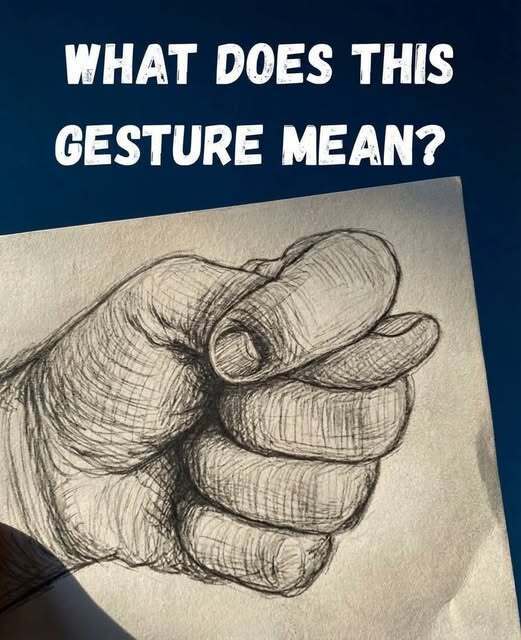
One of the most powerful tools of human communication has always been the hand. Long before writing systems and centuries before digital emojis, people relied on a rich, silent language of gestures to navigate social life.
Among the most intriguing of these is the act of tucking the thumb between the index and middle fingers of a closed fist. Known across parts of Europe and the Mediterranean as the fig or mano fica, this gesture appears simple at first—but its history is layered with symbolism, resistance, and cultural meaning.
To understand its significance, one must look back to times when speaking openly against authority could carry serious consequences. In tightly structured societies, especially in 19th-century rural Europe, everyday people often faced limits on what they could safely say. In that environment, subtle nonverbal expression became a quiet form of defiance. The fig gesture allowed someone to signal refusal or rejection without speaking a word, offering a small but meaningful sense of control in situations where direct opposition was risky.
Beyond its role as silent protest, the gesture also carried spiritual meaning in various traditions. In folklore from regions stretching across the Mediterranean and parts of Eastern Europe, it was believed to offer protection against misfortune or the “evil eye.” The hidden thumb inside the fist was thought to create a symbolic shield, guarding against envy, curses, or negative energy. For some, it was not just communication—it was a form of protection.
Over time, its meaning softened in everyday life. What once functioned as a quiet act of resistance or superstition gradually shifted into playful interaction within families. Elders used it in teasing games with children, and it became part of informal, familiar exchanges rather than serious social statements. The gesture evolved, but it remained a small thread connecting generations through shared nonverbal language.
In earlier eras, it even appeared in emotionally charged moments—farewells, departures, and uncertain separations—where words were difficult or impossible. In such instances, a simple hand sign could carry reassurance, strength, or understanding between people separated by distance or circumstance.
Today, as communication has become increasingly digital and text-based, gestures like this have largely faded from everyday use. Emojis and symbols now replace much of the expressive nuance once carried by the body itself. While modern tools are fast and convenient, they lack the physical presence and cultural depth of traditional gestures.
This shift raises a quiet question: what is lost when meaning moves from the body to the screen? The fig gesture reflects a time when communication was more tactile, more immediate, and often more layered. It shows how people once adapted creatively to express defiance, humor, protection, and identity without ever speaking aloud.
In the end, its story is less about a single hand sign and more about human adaptability. Across centuries, people have always found ways to express what could not be safely said. And even if such gestures are less common today, their legacy remains a reminder that communication has always been more than words—it has also been gesture, presence, and unspoken understanding.
Leave a Reply