
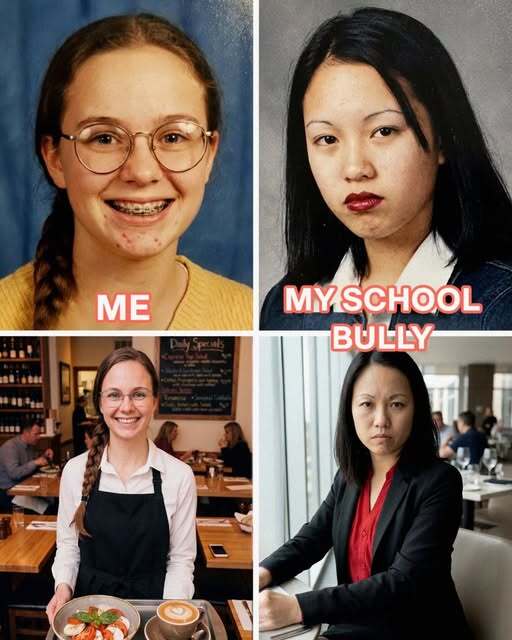
Madison was a predator in the rigid social hierarchy of high school, thriving on the vulnerabilities of anyone she decided was beneath her. Backed by wealth and effortless beauty, she moved through school like she was untouchable—admired by most, feared by many, and questioned by none. To everyone else, she was the golden girl of our graduating class. To me, she was something far more dangerous: a slow, deliberate force that chipped away at my self-worth for four straight years.
She mocked my thrift-store clothes, the worn sweaters my mother bought because she had no other choice, and the cheap shoes that carried me through long school days. She didn’t just notice my struggles—she weaponized them, even sneering at the fact that my mother worked multiple exhausting jobs just to keep us afloat. Madison didn’t need to shout to hurt someone. She was precise, calculated, and cruel.
I survived those years by becoming invisible. I kept my head down, spoke as little as possible, and counted the days until graduation set me free. When I finally walked across that stage, I believed Madison would fade into nothing more than a painful memory.
I was wrong.
Twelve years later, life had reshaped everything. I had built a steady, quiet career as an analyst at a logistics company—spreadsheets, deadlines, and routine offering a sense of control I had never known growing up. But stability shattered the moment my mother was diagnosed with stage three cancer.
The treatments were relentless. Chemotherapy, scans, medication—the costs piled up faster than I could manage. So I swallowed my pride and picked up a second job, working nights as a waitress at an upscale downtown restaurant. Every shift meant another step toward keeping my mother alive. I would have worked twice as hard if it meant giving her more time.
It happened on a humid Thursday evening.
I was clearing a table when I heard it—an unmistakable laugh slicing through the restaurant’s calm atmosphere. My stomach tightened before I even looked up.
Madison.
She sat at table fourteen, dressed in expensive elegance—cream coat, perfect hair, and the same self-satisfied expression I remembered all too well. Recognition didn’t hit her all at once. It came in stages: confusion, curiosity, and then that slow, familiar smile of satisfaction.
She had found something she thought she’d lost.
I approached with the menu, but she barely glanced at it. Her eyes dropped to my name tag instead, her smile sharpening as she leaned back in her chair.
Loud enough for nearby tables to hear, she began commenting on my “career choice,” questioning whether serving drinks to people like her was really the best I could do. I kept my voice steady, offering the usual greetings, but she wasn’t interested in service—she was interested in spectacle.
Then she turned the conversation toward my mother.
Mock concern dripped from every word as she asked if she was still “working those little jobs.” When I asked her to stop, she laughed and called me overly sensitive, like the years between us meant nothing.
The final humiliation came with the appetizer.
Madison slowly tipped her water glass. It toppled, spilling ice and water across her lap and the white tablecloth. She didn’t flinch. She smiled instead.
“Clean it up,” she said casually. “That’s what you’re here for.”
I knelt down, hands shaking—not just from anger, but from exhaustion I thought I had long buried.
And then a hand settled on my shoulder.
Someone stepped forward.
A man in a tailored suit—one of the restaurant’s high-profile guests—appeared beside us. I recognized him vaguely from the executive section earlier that evening.
Madison went pale.
“Ethan…” she whispered.
The color drained from her face as she realized who was standing there. He was her fiancé—the man she had proudly displayed on social media, the future she had carefully curated.
But Ethan wasn’t looking at her the same way anymore.
He looked at the spilled water. At me. At the mess she had created.
And then he spoke, calm but cutting.
He said he had been standing at the bar and had heard everything.
Madison tried to recover instantly, laughing too loudly, claiming it was just “old friends joking around.” She reached for his hand. He pulled away.
His expression had changed completely.
He asked her, plainly, if she had just mocked a woman’s sick mother and humiliated a staff member on purpose.
The room fell silent.
Madison scoffed, dismissing it as drama.
Then Ethan reached into his pocket and placed a small velvet ring box on the table.
He told her he had spent two years believing he was in love with someone kind and genuine. But what he was seeing now wasn’t love—it was performance.
And he was done.
He ended the engagement right there.
The ring box landed on the wet tablecloth like a final sentence.
Madison’s composure shattered. She raised her voice, accused me of ruining her life, called me bitter, and blamed me for everything unfolding around her.
But Ethan didn’t look at me again.
He told her clearly: this wasn’t about me. It was about who she had always been when she thought no one important was watching.
For the first time, Madison had no control over the room.
I quietly stood, lifted my tray, and told her I was just doing my job.
Later that night, as I finished my shift, Ethan found me outside. He apologized—genuinely, almost painfully—for what I had been subjected to. He said he was grateful he had seen the truth before making a lifelong mistake.
Before leaving, he handed me an envelope—far more than I expected, far more than the situation demanded.
I accepted it silently, thinking only of my mother’s next treatment.
At home, I found her awake under a pile of blankets. I sat beside her and told her everything. She cried—not for the money, not for the humiliation—but because she wished she could have protected me all those years ago.
I told her she already had.
She had given me everything I needed to survive: love, stability, and a reason not to break.
Madison had wealth, beauty, and status.
But in the end, she was alone.
And as I sat beside my mother that night, I realized something simple but certain:
I hadn’t just survived her.
I had outgrown her.
Leave a Reply