
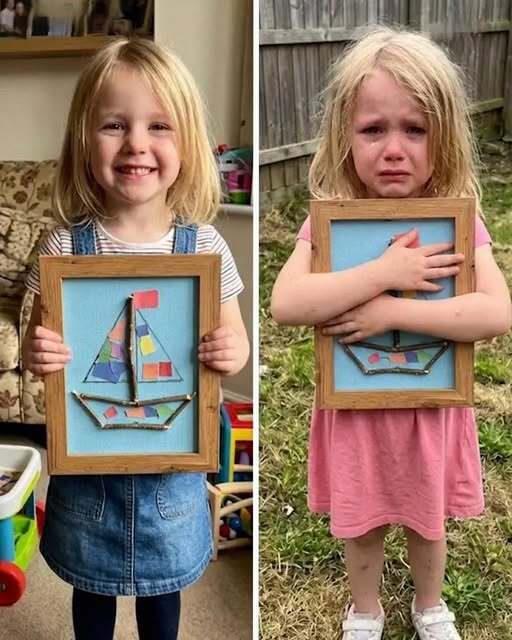
There was a quiet sense of purpose in our home the morning of my nephew Tommy’s sixth birthday party. For days, my five-year-old daughter Mira had been completely absorbed in a project of her own making—something she insisted on doing almost entirely by herself.
She wasn’t interested in store-bought toys or flashy gifts. Instead, she decided she wanted to make something meaningful. For Tommy, who loved anything related to boats, she built a small handmade creation using cardboard, twigs she collected from the park, bits of colored paper, and plenty of glue. I helped only when she asked, but most of it came from her imagination and effort. It wasn’t perfect—crooked edges, uneven shapes, and a slightly wobbly structure—but to her, it was finished art.
She was incredibly proud of it. We placed it carefully into a simple frame, and she wrapped it herself with more excitement than I’ve ever seen from her.
When I asked if she was sure this was what she wanted to give him, she simply said, “Tommy likes boats.”
My sister-in-law Mandy, Tommy’s mother, has always had a very polished way of doing things. Everything around her is carefully curated—gifts, parties, appearances. Over time, there had been subtle comments here and there about things looking “too simple” or “not impressive enough,” but I had always chosen to keep the peace for the sake of family.
The birthday party took place at her home, which was beautifully decorated and full of planned details. I stayed briefly before leaving for a work obligation, trusting that Mira would be safe with family.
About an hour later, my phone rang. It was my mother-in-law. Her voice was shaken.
She told me Mira had been reduced to tears and left sitting alone after something that happened during the gift opening. According to her, Mandy had taken one look at Mira’s handmade present and, in front of the other children and parents, dismissed it as “the worst and cheapest gift there.”
Then, she told my daughter she shouldn’t stay at the party if that was the kind of present she brought.
I remember not fully processing it at first—just a rising sense of disbelief as I got in the car and drove back.
When I arrived, the atmosphere felt different. The usual noise of a children’s party had quieted into something tense. I found Mira sitting off to the side, her face tear-streaked, her hands folded tightly in her lap.
But what I didn’t expect was what happened next.
Tommy had the framed boat in his hands.
Despite his mother trying to redirect attention to the next part of the party, he stood his ground. In a clear, steady voice, he said that Mira’s gift was his favorite. He pointed out the details she had explained to him—the blue paper waves, the shiny foil “sun,” the twigs that formed the boat itself. To him, it wasn’t messy or cheap. It was thoughtful and personal.
Other adults began to react. Some quietly agreed, noting how much effort it clearly represented. The mood shifted as it became harder to dismiss what was in front of them.
Mandy tried to brush it off, insisting it was just a misunderstanding, but the damage was already done. The moment had exposed more than just a disagreement over a gift—it revealed how differently people can value effort and intention.
Tommy made his decision in the simplest way possible: he said Mira was staying, because it was his birthday and she was his best friend. Then he took her hand and led her back toward the party.
From that point on, the rest of the celebration unfolded differently. Tommy proudly showed her gift to others, treating it like something special, not something to be embarrassed about.
Mira stayed quiet for most of the ride home later that day. Eventually, she asked me if she had done something wrong because she didn’t have expensive things.
That question stayed with me.
I told her gently that she hadn’t done anything wrong—that kindness and effort mattered far more than price or appearance.
And in the end, that day became something none of us forgot: not because of the hurt that started it, but because a child reminded everyone what appreciation actually looks like when it’s real.
Leave a Reply